Download A Practical Guide to Fedora and Red Hat Enterprise Linux (7th Edition)
Adhering to the great routine will reveal the great practice, also. When having a great friend that has reading habit, it is needed for you to have that such routine. Well, even reading is really not your design, why don't you try it once? To attract you to love reading, we will offer A Practical Guide To Fedora And Red Hat Enterprise Linux (7th Edition) currently. Below this book tends to be the most referred book that lots of people review it.
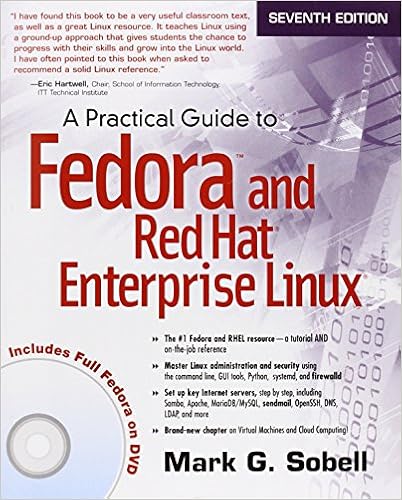
A Practical Guide to Fedora and Red Hat Enterprise Linux (7th Edition)

Download A Practical Guide to Fedora and Red Hat Enterprise Linux (7th Edition)
Reviewing, just what do you think of this word? Is this word burdening you? With numerous works, obligations, and also tasks, are you required so much to do this specific task? Well, also lots of people consider that reading is kind of uninteresting activity, it doesn't mean that you must ignore it. Occasionally, you will certainly require times to invest to review guide. Also it's simply a publication; it can be an extremely worthwhile as well as priceless thing to have.
Often, checking out A Practical Guide To Fedora And Red Hat Enterprise Linux (7th Edition) is very boring as well as it will certainly take very long time beginning with getting the book and begin checking out. However, in modern-day era, you could take the establishing modern technology by using the web. By net, you could visit this page and also begin to hunt for guide A Practical Guide To Fedora And Red Hat Enterprise Linux (7th Edition) that is needed. Wondering this A Practical Guide To Fedora And Red Hat Enterprise Linux (7th Edition) is the one that you need, you can opt for downloading. Have you recognized ways to get it?
Even this book is finished with the presented versions of types; it will not overlook to get to the generosity. To deal with this book, you could locate it in the web link as provided. It will certainly be available to link and also see. From this you could start downloading and install and strategy when to check out. As a suitable book, A Practical Guide To Fedora And Red Hat Enterprise Linux (7th Edition) constantly refers to the people demands. It will not make possibility that will not be related to your necessity.
By clicking the link that our company offer, you could take the book A Practical Guide To Fedora And Red Hat Enterprise Linux (7th Edition) flawlessly. Hook up to web, download, and conserve to your device. Just what else to ask? Reviewing can be so easy when you have the soft file of this A Practical Guide To Fedora And Red Hat Enterprise Linux (7th Edition) in your device. You could also duplicate the file A Practical Guide To Fedora And Red Hat Enterprise Linux (7th Edition) to your workplace computer system or in the house as well as in your laptop computer. Just share this good information to others. Recommend them to visit this resource and get their looked for publications A Practical Guide To Fedora And Red Hat Enterprise Linux (7th Edition).
Master All the Techniques You Need to Succeed with Fedora™ or Red Hat® Enterprise Linux®
In this comprehensive guide, one of the world’s leading Linux experts brings together all the knowledge and real-world insights you need to master and succeed with today’s versions of Fedora or Red Hat Enterprise Linux. Best-selling author Mark Sobell explains Linux clearly and effectively, focusing on skills you’ll actually need as a user, programmer, or administrator.
Sobell assumes no prior Linux knowledge. He starts at the beginning and walks you through every topic and task that matters, using easy-to-understand examples. Step by step, you’ll learn how to install and configure Linux from the accompanying DVD, navigate its graphical user interface, provide file/printer sharing, configure network servers, secure Linux desktops and networks, work with the command line, administer Linux efficiently, and automate administration using Python and bash.
Mark Sobell has taught hundreds of thousands of Linux and UNIX professionals. He knows every Linux nook and cranny—and he never forgets what it’s like to be new to Linux. Whatever you want to do with Linux—now or in the future—you’ll find it in this book.
Compared with other Linux books, A Practical Guide to Fedora™and Red Hat®Enterprise Linux ®, Seventh Edition, delivers
Product details
Paperback: 1408 pages
Publisher: Prentice Hall; 7 edition (January 10, 2014)
Language: English
ISBN-10: 9780133477436
ISBN-13: 978-0133477436
ASIN: 0133477436
Product Dimensions:
7.4 x 2 x 9.1 inches
Shipping Weight: 3.9 pounds (View shipping rates and policies)
Average Customer Review:
4.4 out of 5 stars
101 customer reviews
Amazon Best Sellers Rank:
#176,844 in Books (See Top 100 in Books)
Full disclosure: I am a UNIX/Linux system admin by profession, and we generally don't use the GUIs much. I will say I was slightly disappointed. What's weak? Coverage of systemd and pam and lvm. What's missing entirely? Network bonding, clustering and the Red Hat Satellite server. What else could it use? A whole section on command line account creation and administration. What's very good? The coverage of CUPS is one of the best. There is a lot of good information on scripting. The in-depth explanations are good. There's more, but the book is not in front of me now. The subject of Linux is too large for a single book, and individuals have their own learning styles, but I'd say the Ghori book is the one I look at for day-to-day doing, the Jang book is a better tutorial, and this a better reference. No matter how many books you have, you will still find yourself searching the web for how-to take an lvm snapshot or shrink an ext3 filesystem or update hplip outside of the Red Hat channels. That said, if I ever take the RHCE, I will be reading this book from cover to cover first. I like the book.Save yourself some trouble and skip the Fedora 19 iso included with the book. Download fedora 20 from the web. The installer for Fedora 19 was pretty shaky when it first came out. The F20 one worked better, and as of today, Fedora 20 is current.
Firstly, I am a software engineer (C, C++, Python, Bash), not a system administrator, so my perspective may differ from that of the target audience. That being said, this book is mind-blowingly good.Judging the book by its cover (how often have we heard that's a bad idea?), this book looks and sounds ordinary. However, a quick look inside and you'll see it is anything but. This book covers the basics, starting from a level your grandmother could understand, and works its way all the way to an advanced level where the user will understand how to configure and manage the system, writing Bash scripts to automate the tasks at hand. I can see exactly why this is used as a text book in many college classrooms. If you read this book from cover to cover, you'd go from newbie Linux user to power user.Most importantly to me, this book does not waste your time with crap you don't care about. It is well organized to be used as either a tutorial or reference. Between the table of contents and the index, you can jump right to whatever you need. To avoid redundancy, the author provides "links" (page numbers) to additional material that is either prerequisite knowledge or supplemental reading for the topic.Does this tome (weighing in at about 1,200 pages) cover in full depth every single topic you'll ever encounter? Of course not; that would take 12,000 or more pages. What it does do however, is give you a very, very well rounded knowledge base from which you can probably figure out how to solve your own problems, or at least have a launching base from which to hit Google. That being said, in almost every case (a dozen or more) where I've needed to lookup something, this book exceeds what you'll find on Google.If you will ever have the fortune (and I sincerely mean fortune) of encountering Linux, BUY THIS BOOK.
This is a good book to read about all things Linux and more. If you use CentOS 7, you should have a copy of this book. If you enjoy installing Linux from a minimal install, this book will show you how to get the network card configured without the GUI! You should be able to handle it from there. All in all, this is a great Linux book to own.
This is the most useful all-in-one Linux book I've seen. I consider myself an intermediate level Linux/UNIX user. I wish I had obtained this book five or six years ago.Like a previous reviewer, I decided to wait and obtain this when I saw the sixth edition was about to be released. It was worth the wait. I became aware of this book after examining Sobell's "Practical Guide to Linux Commands, Editors, and Shell Programming" at a local store. I was impressed with that book's breadth and organization. That book uses generic Linux as the basis for explaining Linux. When I saw Amazon offered a Sobell book targeted to Fedora/RHEL, I knew that was the edition I wanted. I recently switched to Fedora Linux after several years of using Ubuntu.If you're in the market for a large Linux book, you'll be happy with either this Fedora book or the "Practical..Commands" edition mentioned previously. Either book will be useful regardless of the Linux flavor you use. The difference between this Fedora book and the "Practical..Commands" book: this one covers administration and server setup tasks extensively. Both books share a lot of material. The "Commands" book also covers many topics that aren't covered here (including Mac OSX). It's worth taking time and reading Amazon's preview which includes the preface. Sobell clearly spells out the differences between the books.The "Commands" book costs less and doesn't include a DVD. But, -- nowadays -- installing Linux from a USB stick is simpler than using a DVD. I suggest to buy the "Practical..Commands" book instead of this Fedora book when you're completely new to Linux. It costs less and covers more of what you don't know. Learn administrative tasks down the road as needed.Finally, a third version called "Practical Guide to Ubuntu Linux" is worth considering also. I imagine a lot of effort went into choosing the content for these three different Linux references.Sobell's writing is crisp and to-the-point. It is almost completely devoid of personality -- by this I mean he eschews lame attempts at humor or grammatical/semantic oddities that mar otherwise great books. One could possibly complain that his writing style is dry or boring. I wouldn't. I don't like books which devote space to "exercises". Fortunately, these are brief. I haven't checked yet, but the answers (some) are said to be posted on the author's web site.The level of detail is perfect for this type of book. For example, you learn how UUIDs are used, but not how they're derived. This book filled gaps in my BASH shell knowledge: stuff I should've known but didn't due to laziness or having glossed over material elsewhere.The book doesn't cover a whole lot about the GNOME shell. When it does have GUI examples it depicts GNOME 3 in "fallback" mode which is similar to GNOME 2. This is a wise editorial choice. Don't expect a ton of GUI stuff anyway; this is mostly CLI. Lots of great stuff on system initialization. Material here is up-to-date and clearly explained. I'm still digesting the sections on system initialization.Would have liked to see a bit of coverage on Webmin, plus other utilities I've used. I suppose you can't have everything.
A Practical Guide to Fedora and Red Hat Enterprise Linux (7th Edition) PDF
A Practical Guide to Fedora and Red Hat Enterprise Linux (7th Edition) EPub
A Practical Guide to Fedora and Red Hat Enterprise Linux (7th Edition) Doc
A Practical Guide to Fedora and Red Hat Enterprise Linux (7th Edition) iBooks
A Practical Guide to Fedora and Red Hat Enterprise Linux (7th Edition) rtf
A Practical Guide to Fedora and Red Hat Enterprise Linux (7th Edition) Mobipocket
A Practical Guide to Fedora and Red Hat Enterprise Linux (7th Edition) Kindle